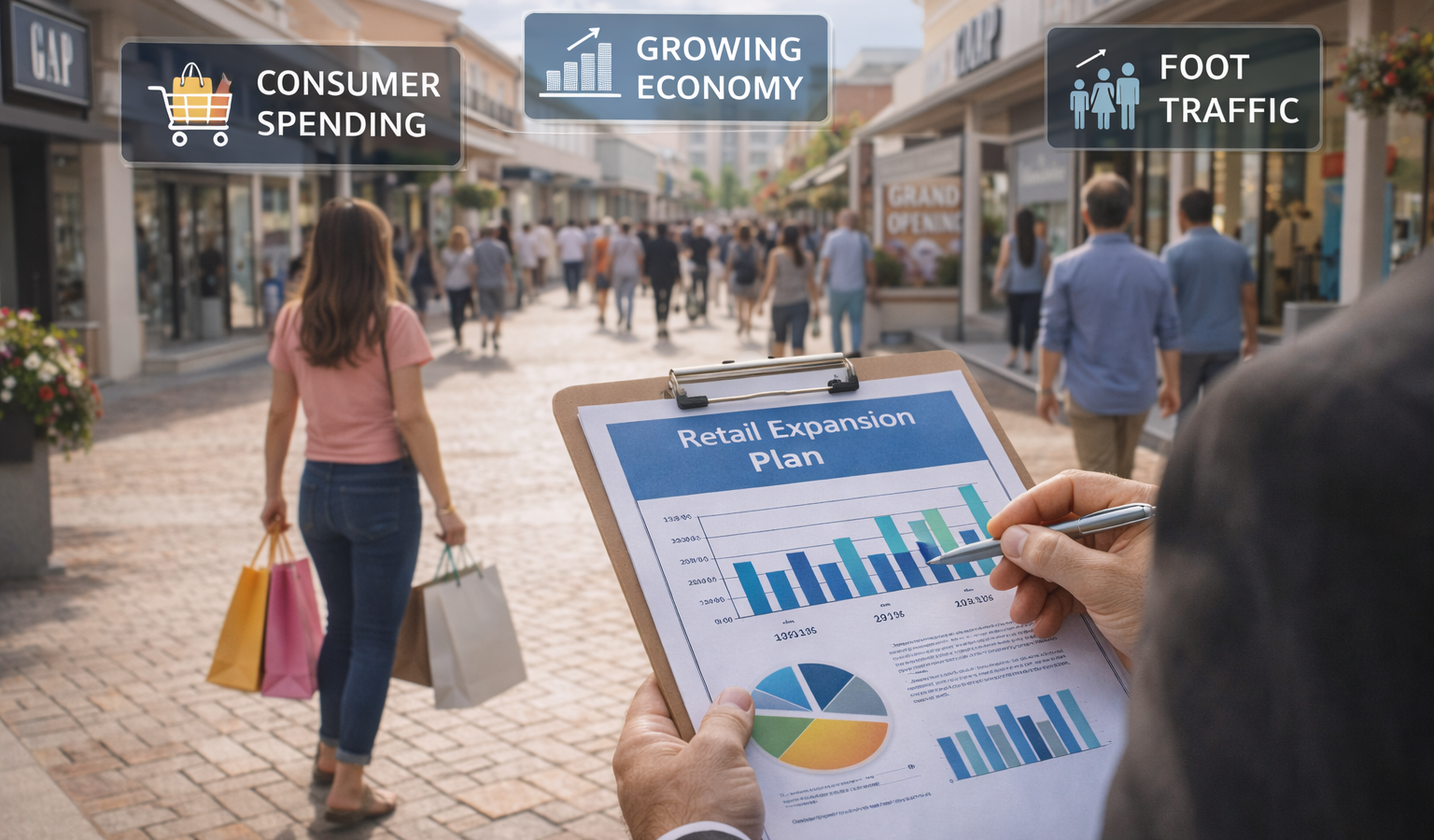
Retail expansion does not happen in isolation. Decisions to open new stores, enter new regions, or scale digital operations are shaped by a complex set of macroeconomic and local market indicators. From consumer spending data to employment trends and interest rate movements, economic signals influencing retail expansion provide essential insight into when and where retailers choose to grow.
In a competitive and rapidly evolving marketplace, expansion strategies must align with both demand conditions and financial sustainability. While optimism may drive brand ambition, economic fundamentals ultimately determine feasibility. Understanding economic signals influencing retail expansion helps investors, policymakers, and business leaders anticipate market shifts and allocate resources strategically.
Consumer Spending as a Core Indicator
At the center of retail expansion decisions lies consumer spending. Retailers closely monitor household consumption patterns to evaluate purchasing power and market demand.
When disposable income rises and consumer confidence improves, spending typically increases. This environment encourages retailers to expand into new territories. Conversely, when households reduce discretionary purchases due to economic uncertainty, expansion plans often slow.
According to the U.S. Bureau of Economic Analysis, personal consumption expenditures represent a significant portion of economic activity. Retailers analyze this data alongside category-specific trends to assess whether demand justifies additional locations.
Economic signals influencing retail expansion frequently begin with sustained growth in consumer spending metrics.
Employment Growth and Wage Trends
Employment stability strongly affects retail performance. Rising job creation and wage growth increase consumer purchasing capacity.
The U.S. Bureau of Labor Statistics reports that labor market expansion often correlates with increased retail sales activity. When more individuals are employed and incomes rise, demand for goods and services typically follows.
Retailers evaluate regional employment data before entering new markets. Cities experiencing job growth in technology, healthcare, or manufacturing sectors often attract retail investment.
Economic signals influencing retail expansion therefore include both national labor indicators and localized employment shifts.
Interest Rates and Financing Conditions
Retail expansion often requires significant capital investment. Leasing commercial space, constructing new stores, and managing inventory all depend on accessible financing.
Interest rates directly influence borrowing costs. When central banks raise rates to control inflation, capital becomes more expensive. Retailers may delay expansion under high-rate conditions.
The Federal Reserve’s monetary policy decisions often signal broader economic cycles. Lower rates typically encourage borrowing and business investment, supporting expansion initiatives.
Monitoring financing conditions is essential for evaluating economic signals influencing retail expansion.
Inflation and Cost Pressures
Inflation affects both consumers and retailers. Rising prices reduce purchasing power while increasing operational costs such as rent, utilities, and inventory procurement.
When inflation accelerates, retailers may focus on optimizing existing operations rather than opening new locations. However, moderate inflation accompanied by wage growth can signal a healthy expansion environment.
The International Monetary Fund tracks inflation trends globally, highlighting their impact on business confidence and consumer stability.
Retailers must assess whether pricing strategies can offset rising costs before committing to expansion plans.
Urbanization and Population Growth
Population growth and urban development are long-term signals influencing retail footprint decisions. Expanding metropolitan areas create demand for new retail centers and neighborhood stores.
The United Nations Department of Economic and Social Affairs projects continued urban population growth worldwide. Retailers evaluate demographic data to identify emerging residential hubs.
In addition to total population growth, age distribution influences retail strategy. Younger demographics may drive demand for technology, fashion, and dining experiences, while older populations may prioritize healthcare and essential services.
Economic signals influencing retail expansion often intersect with demographic forecasting.
Real Estate Market Conditions
Commercial real estate availability and pricing play a crucial role in expansion feasibility. When vacancy rates are high, retailers may secure favorable lease terms.
Conversely, limited availability in prime locations may increase costs and delay entry into competitive districts.
The National Association of Realtors provides commercial real estate data that retailers use to assess market timing.
Retailers also consider foot traffic patterns, accessibility, and co-location with complementary businesses. Real estate trends remain central to evaluating economic signals influencing retail expansion.
Consumer Confidence Index
Consumer sentiment reflects perceptions about economic stability and personal financial outlook. High consumer confidence often signals willingness to spend.
The Conference Board’s Consumer Confidence Index is widely monitored by retailers and investors. Rising confidence levels typically align with increased discretionary spending.
When confidence declines, consumers may prioritize essential purchases and delay nonessential expenditures. Retailers adjust expansion strategies accordingly.
Economic signals influencing retail expansion therefore include both objective financial data and subjective sentiment indicators.
E-Commerce Growth and Digital Integration
Retail expansion is no longer limited to physical storefronts. Digital sales growth influences decisions about warehouse capacity, distribution centers, and omnichannel infrastructure.
E-commerce expansion often complements physical growth strategies. Retailers analyze online demand patterns to determine whether certain regions warrant brick-and-mortar presence.
The U.S. Census Bureau reports consistent growth in e-commerce sales, reinforcing the importance of digital integration in expansion planning.
Hybrid retail models reflect economic signals influencing retail expansion across both physical and digital domains.
Supply Chain Stability
Reliable supply chains support inventory consistency and customer satisfaction. Disruptions can delay expansion or increase operational risk.
Global trade patterns, transportation costs, and geopolitical stability influence supply chain resilience.
Organizations such as the World Trade Organization monitor trade flows that indirectly affect retail operations.
Retailers increasingly incorporate supply chain risk assessments into expansion planning, ensuring that new markets can be served efficiently.
Government Policy and Incentives
Local governments often offer incentives to attract retail investment. Tax abatements, infrastructure improvements, and zoning adjustments can encourage expansion.
However, regulatory requirements and compliance costs also influence site selection.
Public policy environments that support business development often align with positive economic signals influencing retail expansion.
Retailers weigh incentives against long-term operational considerations when evaluating new markets.
Technology Adoption and Consumer Behavior
Advancements in payment systems, data analytics, and inventory management tools enhance expansion readiness. Retailers equipped with advanced analytics can forecast demand more accurately.
Consumer behavior shifts—such as preference for experiential retail or sustainable products—also influence store design and location decisions.
Technology supports agile responses to changing economic signals influencing retail expansion, allowing retailers to adjust footprints dynamically.
Economic Cycles and Risk Assessment
Retail expansion strategies must consider broader economic cycles. During periods of economic growth, expansion accelerates. During recessions, retailers may consolidate operations.
Risk assessment models incorporate multiple economic signals, including GDP growth, unemployment rates, and inflation expectations.
Balanced expansion planning involves scenario analysis to anticipate potential downturns.
Retailers that expand cautiously during strong cycles often demonstrate greater resilience during slowdowns.
Long-Term Outlook
Looking ahead, economic signals influencing retail expansion will continue evolving alongside digital transformation and demographic change.
Sustainable retail growth will depend on aligning expansion decisions with consumer demand, financial stability, and technological innovation.
Retailers increasingly adopt flexible store formats, allowing rapid adaptation to changing market conditions. Pop-up locations, micro-fulfillment centers, and experiential showrooms provide scalable growth pathways.
Monitoring real-time economic data will remain essential for informed expansion strategy.
Conclusion
Economic signals influencing retail expansion shape how and where retailers choose to grow. Consumer spending patterns, employment growth, financing conditions, inflation trends, demographic shifts, and technological innovation all contribute to expansion decisions.
Retailers that analyze these indicators comprehensively are better positioned to balance ambition with sustainability. While economic cycles may introduce volatility, strategic alignment with fundamental signals supports long-term resilience.
As global markets continue evolving, retail expansion will remain closely tied to economic health and consumer behavior. Understanding these interconnected signals enables more informed investment, smarter planning, and sustainable growth in competitive retail landscapes.
References
U.S. Bureau of Economic Analysis – Personal Consumption Data: https://www.bea.gov
U.S. Bureau of Labor Statistics – Employment Trends: https://www.bls.gov
Federal Reserve – Monetary Policy Reports: https://www.federalreserve.gov
United Nations Department of Economic and Social Affairs – Urban Population Data: https://www.un.org