
Efficiency has become less about doing more and more about reducing friction. As work, home management, and personal responsibilities increasingly overlap, people are looking for ways to simplify everyday tasks without adding complexity. This shift has made technology tools enhancing everyday efficiency a major trend across personal productivity, household management, and professional life.
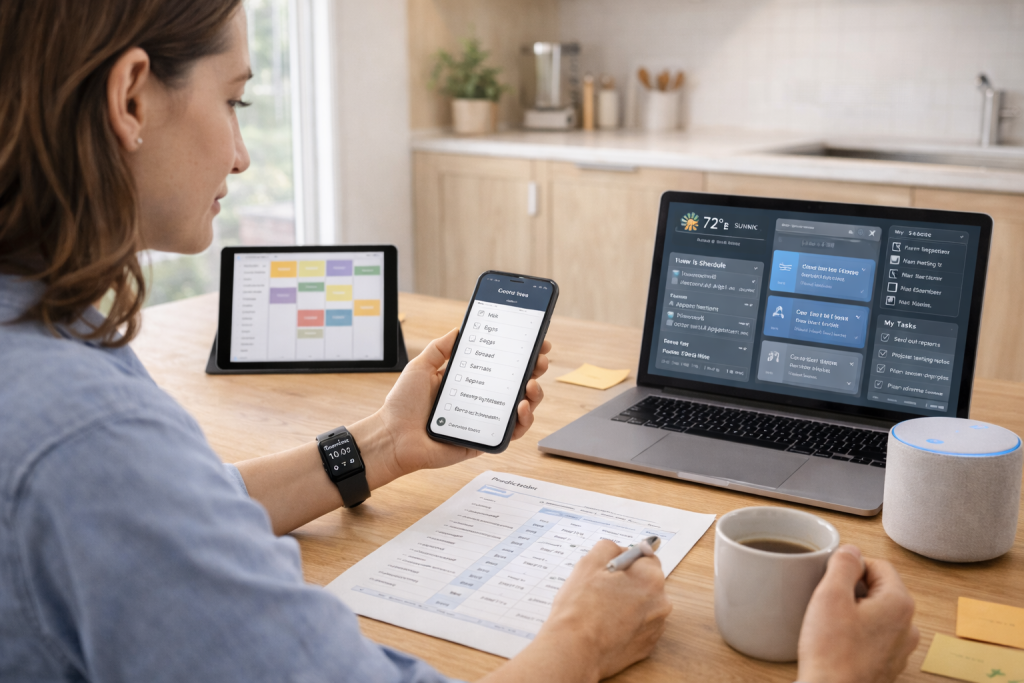
Unlike earlier waves of productivity technology, today’s tools focus on automation, integration, and decision reduction. The goal is not to optimize every minute, but to free up mental space and time for higher-value activities. This article explores why efficiency-focused tools are gaining traction, which categories are most impactful, and how people are using them in practical, sustainable ways.
Why Everyday Efficiency Has Become a Priority
Modern life is characterized by constant context switching. Emails, messages, notifications, and administrative tasks compete for attention alongside core work and personal priorities. Over time, this creates cognitive overload rather than productivity.
Research on knowledge work and digital overload published by Harvard Business Review shows that reducing unnecessary tasks often improves performance more than working faster. As a result, technology tools enhancing everyday efficiency are designed to remove low-value effort rather than accelerate everything.
Automation as a Foundation for Efficiency
Automation is one of the most powerful drivers of everyday efficiency.
Automating Repetitive Tasks
Many modern tools focus on identifying repeatable actions and handling them automatically.
Common examples include:
- Automatic bill payments
- Recurring task creation
- Rule-based email sorting
- Scheduled data backups
Automation reduces the need for constant attention and prevents small tasks from accumulating.
Technology adoption research referenced by McKinsey Global Institute shows that even simple automation significantly reduces time spent on routine administrative work.
Event-Triggered Workflows
Beyond schedules, tools increasingly rely on triggers.
Examples include:
- Creating tasks when emails arrive
- Updating spreadsheets when forms are submitted
- Sending reminders based on deadlines
These workflows reduce manual coordination and improve reliability.
Integrated Task and Workflow Management
Fragmented systems are a major source of inefficiency. As a result, tools that consolidate planning and execution are gaining popularity.
Centralized Task Management
Rather than managing tasks across notes, emails, and memory, users are adopting centralized task systems.
Benefits include:
- Clear prioritization
- Reduced mental tracking
- Easier progress review
Work management research from Gartner highlights task consolidation as a key factor in reducing decision fatigue.
Linking Tasks to Context
Modern task tools allow tasks to be linked to projects, deadlines, and collaborators. This context reduces ambiguity and speeds up decision-making.
This structure is central to technology tools enhancing everyday efficiency because it minimizes time spent figuring out what to do next.
Digital Calendars as Efficiency Hubs
Calendars are evolving from scheduling tools into coordination systems.
Time Blocking and Predictability
People increasingly use calendars to block time for focused work, personal tasks, and rest.
Benefits include:
- Reduced over-commitment
- More realistic planning
- Fewer interruptions
Time-use studies referenced by OECD show that structured scheduling improves perceived control over time.
Calendar-Task Integration
Efficiency improves when calendars and task lists are connected. Tasks scheduled directly into calendars reduce procrastination and last-minute stress.
Communication Tools Designed to Reduce Noise
Communication overload is one of the biggest efficiency challenges.
Asynchronous Communication Tools
Instead of constant real-time messaging, teams and individuals are adopting tools that support delayed responses.
Benefits include:
- Fewer interruptions
- More thoughtful replies
- Better focus blocks
Workplace research published by Microsoft WorkLab shows that asynchronous communication improves productivity and well-being when used intentionally.
Notification Control and Prioritization
Efficiency-focused tools allow users to control when and how they are notified.
This includes:
- Priority-based alerts
- Scheduled notification windows
- Digest summaries instead of real-time pings
Reducing notification noise is a core principle of technology tools enhancing everyday efficiency.
Smart Home and Personal Management Tools
Efficiency trends extend beyond work into daily life management.
Household Automation
Smart home systems automate routine household tasks.
Examples include:
- Programmable lighting and climate control
- Automated appliance scheduling
- Voice-controlled reminders and lists
Energy and lifestyle research referenced by International Energy Agency links smart home automation to both time savings and reduced cognitive load.
Centralized Personal Dashboards
Some tools consolidate personal information such as:
- Bills and subscriptions
- Appointments and deadlines
- Health or habit tracking
Having information in one place reduces search time and forgotten tasks.
Financial Tools That Reduce Manual Effort
Financial management is a major source of everyday friction.
Automated Budgeting and Tracking
Modern financial tools automatically categorize transactions and highlight trends.
Benefits include:
- Less manual data entry
- Faster insight into spending patterns
- Reduced financial stress
Consumer finance research from the Consumer Financial Protection Bureau shows that automation improves consistency in financial management.
Subscription and Expense Monitoring
Tools that track recurring charges and alert users to changes prevent unnoticed spending and unnecessary complexity.
Information Management and Search Efficiency
Finding information is often more time-consuming than creating it.
Searchable Knowledge Systems
People are adopting tools that store notes, documents, and references in searchable formats.
Key advantages include:
- Faster retrieval
- Reduced duplication
- Easier long-term organization
Knowledge management research highlighted by Deloitte emphasizes search efficiency as a major productivity driver.
Linking Information Across Tools
Efficiency improves when notes, tasks, and documents are connected. This reduces the need to remember where information lives.
AI-Assisted Efficiency Tools
Artificial intelligence is increasingly used to reduce routine cognitive effort.
Summarization and Prioritization
AI-powered tools help by:
- Summarizing long messages or documents
- Highlighting key action items
- Suggesting priorities based on patterns
Research on applied AI in productivity tools referenced by Stanford University Human‑Centered AI shows that these features can significantly reduce time spent on information processing.
Decision Support Rather Than Decision Making
Importantly, efficiency-focused AI tools support decisions rather than replace them. They reduce preparation time while leaving judgment to the user.
This distinction is critical to sustainable use.
Habit-Supporting Technology
Efficiency improves when tools reinforce consistent behavior.
Routine Automation
Many tools allow routines such as:
- Daily task resets
- Weekly planning templates
- Regular review reminders
These routines reduce friction around starting and maintaining habits.
Behavioral science research summarized by Behavioral Science & Policy Association shows that reduced initiation effort strongly predicts habit adherence.
Reducing Decision Fatigue
By standardizing recurring choices, efficiency tools free mental energy for more important decisions.
Why Efficiency-Focused Tools Are a Long-Term Trend
The popularity of technology tools enhancing everyday efficiency is driven by structural changes, not novelty. Work complexity, information volume, and role overlap are unlikely to decrease.
As a result, tools that reduce friction rather than add features are becoming essential infrastructure. Their value lies in invisibility: the best tools feel like they remove effort rather than demand attention.
Final Thoughts
Efficiency today is about clarity, not speed. Technology tools that automate routine tasks, integrate systems, and reduce decision-making overhead are reshaping how people manage everyday life.
By focusing on removal rather than addition, technology tools enhancing everyday efficiency help people reclaim time, attention, and energy. In a world of constant demand, that quiet support may be one of the most valuable roles technology can play.
References
- Harvard Business Review – https://hbr.org
- McKinsey Global Institute – https://www.mckinsey.com/mgi
- Gartner – https://www.gartner.com
- OECD – https://www.oecd.org
- Microsoft WorkLab – https://www.microsoft.com/worklab
- International Energy Agency – https://www.iea.org
- Consumer Financial Protection Bureau – https://www.consumerfinance.gov
- Deloitte – https://www.deloitte.com
- Stanford Human-Centered AI – https://hai.stanford.edu
- Behavioral Science & Policy Association – https://behavioralpolicy.org